
Enhance your Security using Obfuscation: the Best Obfuscated VPN
Intro to the World of VPN Obfuscation (and the best Obfuscated VPN)
Defining VPN Obfuscation
In the always-evolving digital landscape, your online security and privacy are paramount. VPN obfuscation comes to the rescue when you wish to elevate your anonymity to the next level. Imagine your VPN traffic wearing an invisibility cloak — that’s obfuscation for you. It’s a clever technique that masks your encrypted data, making it look like regular internet traffic.
The Importance of Securing Your Privacy
Now more than ever, safeguarding your digital privacy is critical. Every byte of data you send across the internet carries a piece of your digital identity, which, if intercepted, can be exploited. With governments, ISPs, and cybercriminals potentially tracking your online moves, maintaining privacy isn’t just about avoiding prying eyes — it’s about protecting yourself from surveillance, identity theft, and other malicious activities. An obfuscated VPN serves as a robust shield, ensuring that your sensitive information remains confidential and out of the wrong hands.
Enabling Obfuscated Servers in NordVPN
Here’s how easy it is to enable (and use obfuscated servers) in NordVPN. They’re included in standard subscription so no additional charge.
The Mechanics Behind Obfuscated Servers
How Do Obfuscated Servers Work?
Obfuscated servers are the undercover agents of the VPN world. When you connect to one, the server scrambles your data packets in such a way that anyone inspecting them would see them as ordinary internet traffic rather than VPN-encrypted data. They employ a mix of encryption and data transformation to evade detection and bypass blocks, acting as your secret passage through the restrictive walls of censorship and surveillance. This ensures you can access the internet freely without leaving a trace that you’re using a VPN.
[Include a diagram illustrating the data packet transformation process]
Main Technologies Utilized for Obfuscation
The world of obfuscation relies on an array of cutting-edge technologies to provide that additional veil of secrecy. Some of the main ones include OpenVPN with XOR scrambling, Stunnel, Obfsproxy, and Shadowsocks. What they all have in common is their ability to take VPN traffic and either dress it up to look like regular HTTPS traffic or scramble it beyond recognition. This magic is done by tweaking the data at a byte level and using common web ports to make your VPN traffic indistinguishable from everyday internet usage.
Does VPN Usage Increase with Higher Censorship?
VPN usage tends to increase with higher levels of censorship. As governments and corporations attempt to reclaim control of the internet by creating digital borders, more people turn to VPNs to maintain their online privacy and freedom of speech.
When and Why to Use an Obfuscated VPN Service
Bypassing Censorship and Restrictions
Imagine hitting a wall every time you try to access the information or social platforms you need — that’s what harsh censorship feels like. Obfuscated VPN services come equipped to tackle this challenge head-on. Whether it’s during crucial political events or in environments with stringent digital censorship, these services work tirelessly to provide an open, unrestricted internet experience. They help get past even the toughest of network firewalls, enabling you to browse the sites you want, without your VPN usage being tracked or blocked.
Enhancing Privacy and Security on Stringent Networks
When you’re navigating high-risk digital environments, such as a public Wi-Fi network or a country with strict online surveillance measures, standard VPN encryption might not suffice. This is where obfuscated VPN services shine by reinforcing your privacy armor. Beyond a typical VPN connection, they offer an intricate layer of security that stands guard against deep packet inspection (DPI) and aggressive data monitoring, ensuring you remain anonymous and your sensitive information stays protected—even under the scrutinizing eye of cyber watchdogs.
“Security used to be an inconvenience sometimes, but now it’s a necessity all the time.”
John Falmouth, CISSP
Choosing the Right Obfuscated VPN for Your Needs
Top Factors to Consider
Choosing the right obfuscated VPN requires careful consideration. Start by checking if the service specifically mentions obfuscation—this is a must. Look for robust no-log policies that guarantee your data won’t be stored or shared. The strength and variety of encryption protocols offered is also key. Verify the server distribution to ensure you can access global content with ease. Finally, evaluate the ease of use. Can you toggle obfuscation on and off easily? Is the user interface intuitive? These factors will lead you to a service that not only enhances your privacy but also fits seamlessly into your internet usage.
Best VPNs with Obfuscation Features
When scouting for the best-in-class obfuscated VPNs, a few names stand out:
NordVPN: NordVPN has cemented its place as a leader thanks to its double-layered encryption and a plethora of obfuscated servers. They excel in bypassing VPN blocks, particularly in countries like China.
- Top 5 Features:
- Double VPN
- Obfuscated servers in numerous countries
- CyberSec suite to block ads and malicious sites
- Automatic kill switch
- Onion Over VPN
- Benefits:
- Enhanced security through layered encryption
- Reliable access in restrictive countries
- Protection from intrusive ads and potential threats
- Continuity of protection even if the connection drops
- Access to the dark web with extra protection
- Cons:
- Slightly higher cost
- Complex setup for non-technical users
- Best for: Users who need top-notch security with extra layers of protection.
ExpressVPN: With impressive speed and reliability, ExpressVPN makes bypassing tough restrictions look easy, requiring no special setup for its obfuscation feature.
- Top 5 Features:
- Proprietary Lightway protocol for speed
- Automatic obfuscation on select servers
- No activity or connection logs
- IP address masking
- Split tunneling
- Benefits:
- Fast connections without compromising security
- Hassle-free experience with auto-enabled obfuscation
- Strict privacy policy to ensure data integrity
- Hides real IP even during a temporary loss of connection
- Choice of which apps use the VPN
- Cons:
- More expensive than some competitors
- Limited simultaneous connections
- Best for: Those seeking fast, reliable VPN access with hassle-free obfuscation.
For a comprehensive list, please refer to the table comparing our VPN recommendations with the best obfuscation features and technology.
Get NordVPN – the #1 VPN

Setting Up Your Obfuscated VPN Connection
Step-by-Step Guidance for Different Devices
Setting up an obfuscated VPN connection might vary slightly depending on your device, but the process generally follows a few simple steps.
For Windows and macOS users, download the VPN client, install it, and then head to the settings or advanced settings within the app. Often, you’ll select the OpenVPN protocol and then choose an obfuscated server from the specialty servers list.
On iOS and Android devices, installation is typically done through the respective app stores. Once installed, you’ll need to navigate to the app settings to find and enable the obfuscation feature, if it’s not already active by default.
If you’re running Linux, setting up obfuscation can be more hands-on. You might need to configure the VPN through the Terminal using specific commands depending on your VPN provider’s guidelines.
Remember, for detailed instructions, always refer to your VPN provider’s help center or setup guides for obfuscation.
Troubleshooting Common Obfuscation Issues
If you’ve set up your obfuscated VPN and run into issues, don’t fret; most are solvable with some straightforward steps. Start by checking your internet connection without the VPN to rule out a non-VPN related issue. If all’s well there, switch between different obfuscated servers — sometimes, it’s as simple as that. Ensure the obfuscation feature is, in fact, enabled in your VPN’s settings. It’s also beneficial to update your VPN application since the latest version often fixes known bugs. When in doubt, don’t hesitate to contact your VPN’s customer support, as they can provide specialized guidance for your situation.
The Pros and Cons of VPN Obfuscation
Benefits of Using Obfuscated Servers
Using obfuscated servers is like having a VIP backstage pass to the internet. They allow you to slip past virtual barriers unnoticed, shield your activities from scrutiny, and connect you globally without leaving a digital footprint. These servers are invaluable for journalists, activists, and anyone else who requires ultimate discretion online. Plus, they provide peace of mind by securing your connection on public Wi-Fi and thwarting data throttling by ISPs, which often target identifiable VPN traffic.
Potential Drawbacks to Be Aware Of
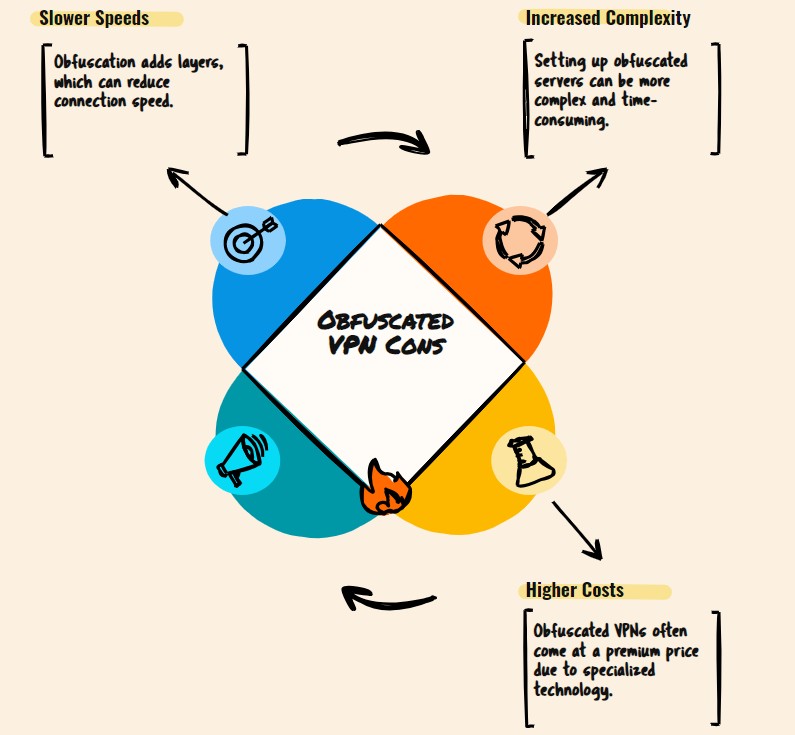
While obfuscated servers offer significant benefits, they’re not a one-size-fits-all solution. Because they work harder to disguise your data, they can potentially slow down your internet connection due to the additional processing required. Users with already slow internet may find using obfuscated servers a bit cumbersome. Furthermore, depending on your locale, using such privacy tools could conflict with local laws or service agreements, so staying informed of your region’s regulations is crucial.
FAQs: Answering Your Queries About Obfuscated VPNs
Is VPN obfuscation legal and safe?
VPN obfuscation is generally safe and a smart way to protect your online activities, provided you use a trusted VPN provider. However, the legality of using any VPN, including obfuscated services, varies by country. It is legal in many places but could be against the law or regulated in others. Always confirm your local laws before using obfuscated VPN services to ensure you are not inadvertently breaking any regulations.
Which Countries are VPNs illegal in?
VPNs are illegal in the following countries:
- Belarus: Since 2015, the Belarusian government has aimed to block technology that anonymizes internet usage, such as Tor. VPNs are illegal in the country.
- Iraq: VPNs are illegal in Iraq for bypassing the government’s strict internet censorship regime.
- North Korea: The use of VPNs is illegal and carries severe penalties, including imprisonment.
- Turkmenistan: VPNs are illegal in Turkmenistan due to strict government control over internet access.
There are many countries which have some restrictions on the actual usage of VPNs and indeed these change all the time so check your local laws.
Can obfuscated VPN technology improve internet speed?
Technically, obfuscated servers add an extra encryption layer, which could slow down your internet speed a notch. Yet, this isn’t the whole story. If your internet service provider (ISP) throttles your connection based on traffic patterns, using an obfuscated VPN can mask your activities and actually help you avoid such throttling, possibly resulting in improved speeds. It’s a bit of a balancing act.
[Insert graph showing speed test results with and without obfuscation technology]
Will a VPN with obfuscation work for streaming services?
Yes, a VPN with obfuscation can be a game-changer for streaming services, especially if they’re geographically restricted. Obfuscated servers disguise your VPN traffic, making it tougher for these services to detect and block you. However, success is not guaranteed, as some streaming platforms employ rigorous measures to identify and restrict VPN use, regardless of obfuscation.
How Can you tell if a server is truly obfuscated?
To know if a server is truly obfuscated, you’ll typically rely on your VPN provider’s word, as they designate specific servers or options for obfuscation. Additionally, successful connection to a service or website that usually blocks VPN traffic can be a clear indicator that obfuscation is working. Tools or tests to detect VPNs might also help you verify if the obfuscation is effectively disguising your VPN traffic.