
Finding a US Netflix VPN Service That Works
Best Proxy for Netflix
There is something of a battle going on across the internet and it looks like it’s going to continue for a long time. On the one side are the media giants of the internet, companies like Netflix, Amazon, BBC and Hulu who supply streaming media services to millions across the planet, on the other are the users of these services who use the better VPN services when they access the internet. The growth of the VPN (virtual private network) has been pretty incredible, once they were primarily used for very high security connections such as people dialing back into corporate networks to access confidential servers. Nowadays millions of people use them for everyday browsing and accessing secure sites online, they also use them to bypass the various blocks and filters which have been established by the media companies – but what is really the a good US Netflix VPN.
This is a big problem for the media companies, many of whom have very specific licensing agreements which allow them to broadcast in specific countries. This however has led to huge disparities in the service offered across different countries – the Netflix service in some countries offers a very small proportion of the movies and shows available in US Netflix for example. Not surprisingly people use VPNs to allow them to switch to the better services, in fact it is estimated that there were nearly half a million Australian Netflix subscribers before it was even available in that country! The practice was pretty much ignored until recently, most of the media companies blocked the easier to detect proxies but didn’t do anything about the many VPN users, until recently.
There’s obviously something happening behind the scenes, likely the content providers themselves are forcing the media companies to enforce the licensing agreements. It’s a crazy situation where online media is still licensed in this way, instead of globally which is after all how the internet was meant to work. The reality is that millions of VPN users are now finding their service blocked or restricted in the wake of this clampdown. Netflix have been particularly aggressive in blocking access to people using a VPN, it used to be simple but now you’re liable to get the following message –
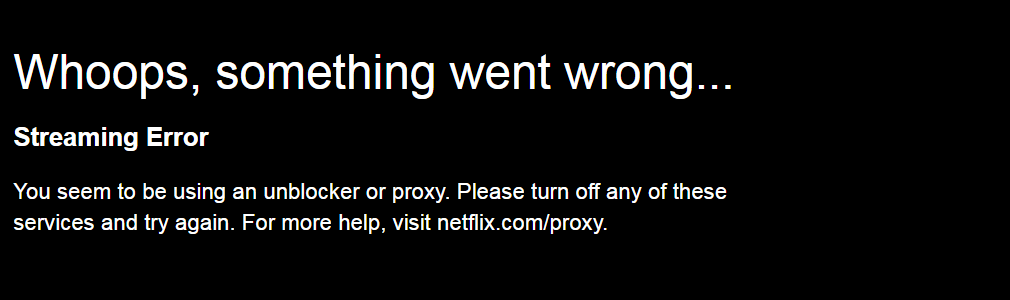
Quite a friendly, happy message but it’s meant millions have been either blocked completely from accessing Netflix or restricted to using the one offered in their own country. Some VPNs still work, however before I give some clues to how to choose a US Netflix VPN, I’d first like to clarify a couple of points that I see in comments on this site and across the internet.
- First, a VPN is not illegal, criminal or anything like that. It is perfectly legitimate to use a VPN all the time when you connect to the internet and many millions do to protect their security and privacy.
- You are also not committing a criminal act by using an American VPN to access US Netflix from somewhere like Canada, UK or Europe. At the very worst you are breaking the Netflix Terms and Conditions and could get your subscription cancelled – though it’s not happened to anyone yet as far as I’m aware.
- VPNs are now useless because they can be detected by media websites, this is incorrect. A VPN service still provides you with encryption and privacy whilst you’re online and they are still very smart thing to use particularly if you’re travelling and using unknown Wi-Fi hot spots and networks. The media companies block these VPN connections by building up lists of IP addresses which they suspect to be VPNs.
This is the reality of the situation, although it’s virtually impossible to detect the use of a VPN – companies like Netflix can build up lists of IP addresses used by VPN services and put them into a blacklist denied access. This is quite easy to do, and many companies are doing this – it’s the reason ITV Hub isn’t working with VPNs at the moment. They simply target high profile online services who advertise a lot and they also monitor which IP addresses are used for multiple, simultaneous connections.
When choosing the best VPN for Netflix and other services, there’s a few simple rules to follow. Firstly, look for a low-key web site which doesn’t openly advertise the facility to watch these services. One of my favorite pre-purge options for watching US Netflix was a successful company called Overplay and their Smart DNS service, their servers were among the first to be blocked and stopped working for me several months ago for Netflix. They have also aggressively targeted the online TV watching facilities, both directly on their websites and through advertising.
Choose a VPN service which doesn’t mention the media companies, they still work the same way but are less likely to get blocked.
Be cautious, particularly if your primary requirement is a VPN to watch a specific region of Netflix. What is currently happening, is a cat and mouse game – Netflix will block a range of IP addresses and access will be blocked, the VPN service will switch out these ranges and replace with others enabling them to work with Netflix again. This has been continuing over the last few months and there’s no way of knowing how long this will last. It is time consuming and expensive for both sides in the war, and the result probably depends on whether Netflix continues their efforts to block all VPN servers.
Update – Netflix have now blocked almost all VPN services from accessing their site by restricting access to only residential IP addresses. However. have issued an update and expanded their network to include residential addresses. I’ve been testing for a couple of weeks, and it now works perfectly for US Netflix – you can try it here – Identity Cloaker Trial. It’s now not only the Best VPN for Netflix but one of the only ones that now works, currently you can only access the US version of Netflix but that’s expected to expand although this is the version that most VPN users want access to.