
Last Updated on November 26, 2026
ARTEX? The Autonomous AI Hacking Tool
So, when most of us think about artificial intelligence, we’re probably thinking about something like ChatGPT answering questions, making stupid videos, generating images or helping us write computer code. But can you imagine what happens when you connect any AI model to a collection of cybersecurity tools and give it the ability to make decisions independently? Well, that’s essentially the concept behind ARTEX, an autonomous penetration testing framework (or someone would say hacking tool) that has attracted considerable attention from cybersecurity researchers since its release in July 2026.
It began as software intended for security professionals but has since been associated with an increasing number of real-world cyberattacks against banks, technology companies and potentially government agencies.
ARTEX isn’t an artificial intelligence model
One of the important distinctions about ARTEX is that it isn’t itself a large language model. It’s not AI and it actually can work without it too, although not nearly as effectively.
Instead, it’s a software framework that connects external AI models with conventional cybersecurity tools. Research published by Censys describes a platform written in the Go programming language, with a browser-based management interface and a PostgreSQL database. So the basic idea is to allow multiple AI agents a framework where they can cooperate on complex security assessments. So instead of simply providing suggestions to a human operator, the software can evaluate information, make decisions and perform parts of a security assessment automatically.
Now for legitimate penetration testers, this offers obvious benefits. These sort of things used to be done manually by entire teams although in recent years the actual atacks and tests have been automated. Security assessments obviously can involve large amounts of repetitive work, much of which is potentially suitable for automation. 
Artex takes this too ano0ther level – automating pen tests, and then lettiing AI analyse the results and configure further tests/attacks. Unfortunately, the distinction between authorised security testing and a criminal intrusion often comes down to permission and intent rather than the software being used. If you’re a hacker or a penetration tester operating with permission – both would use the tool in a very similar way.
Why ARTEX spread so quickly
ARTEX was initially published on GitHub on 26 July 2026 as an open-source project. It attracted a lot of attention very quickly, which is hardly surprising – a world class, super intelligent automated hacking tool available for free! According to cybersecurity researchers at Censys, it attracted an estimated 1,500 to 2,000 GitHub stars within approximately ten weeks.
However, following reports of its involvement in malicious activity, the developer withdrew the original repository on 8 October. But it had been downloaded a lot, very quickly. By then, the source code had already been widely distributed. Independent copies and modified versions continued to circulate.
On 4 November, Censys identified 1,465 internet-accessible hosts running ARTEX consoles. Interestingly, around 650 belonged to two groups of similarly configured hosting infrastructure.
These figures should not be interpreted as a count of individual hackers. Some installations may belong to legitimate security researchers, while others may be operated by the same individuals or organisations. Privately hosted installations would also be missing from the survey. In reality we really don’t know who’s using it, for what purposes and where from.
Nevertheless, the research demonstrates how quickly this type of software can spread.
What makes autonomous hacking different?
Traditional cybersecurity tools have been capable of automating individual tasks for decades. I remember welll, IBM consultants wandering around with little USB sticks plugging them into networks I was running. They selected attacks to perform and then sloped off to find the canteen, while a report was generating. The difference with agent-based systems is their ability to interpret results and adjust their behaviour with considerably less human involvement.
Google’s Threat Intelligence Group has investigated real incidents involving these frameworks. Its findings suggest that automated activity can be remarkably fast, but also relatively noisy compared with the work of an experienced human operator. This has always been the distinction between someone who genuinely knows what they are doing compared to someone who’s just selecting from a menu in Metasploit.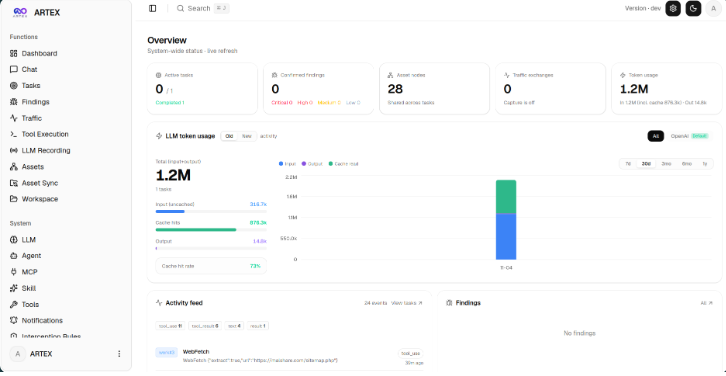
This is an important limitation. Automated attacks can generate substantial amounts of suspicious activity, potentially making them easier to detect. However these tools can conduct and attack without break so it really doesn’t take long – and if your IDS system isn’t able to lock out the attacks automatically then you need to act fast.
The huge difficulty for defenders is responding quickly enough, even with a dedicated IT security team it can be difficult and those aren’t that common anyway.
Cybersecurity company Barracuda experienced this problem first-hand in November. Its investigation into an intrusion involving several cloud systems found evidence consistent with ARTEX. The incident lasted approximately 44 hours and began with the misuse of an existing cloud access key. Even a company specialising in cybersecurity can be vulnerable when a forgotten credential provides an attacker with a golden opportunity.
The video below looks at ARTEX and its possible connection to the recent US government cyberattacks.
Is AI making conventional cybersecurity obsolete?
Not necessarily. The UK’s National Cyber Security Centre argues that many of the weaknesses being exploited by autonomous frameworks are already well understood. Outdated applications, excessive access permissions, poorly protected credentials and forgotten systems remain significant security problems. AI makes it harder for organisations to rely on the assumption that obscure or neglected infrastructure will escape an attacker’s attention.
Maintaining software updates, limiting account privileges, monitoring unusual activity and removing unnecessary access remain important defensive measures. ARTEX itself may eventually disappear or be replaced by more capable alternatives. Its significance lies in what it represents: the combination of increasingly capable AI models with established cybersecurity software.
We’re moving towards an environment where sophisticated cyberattacks may require fewer people, less technical expertise and considerably less time. ARTEX may be one of the first but there will be many more and they’ll get increasingly more sophisticated and probably much easier to use,.
For anyone responsible for protecting computer systems, that’s a development worth taking seriously.
Sources and technical research:
