
Last Updated on September 14, 2026
WDTT Disguised VPN Traffic Inside VK Video Calls
Russia has been steadily increasing its ability to detect and block VPN traffic. Traditional VPN connections can often be identified by deep packet inspection, blocked by protocol, or disrupted by targeting known VPN servers and data-centre IP addresses.
That has led to a growing number of circumvention tools designed to make encrypted traffic look like something else.
One of the more unusual examples is WDTT, short for WireGuard over TURN Tunnel.
Instead of presenting itself as an obvious VPN connection, WDTT is designed to make the traffic resemble ordinary encrypted video-call traffic. The implementation I tested uses the infrastructure behind VK, the large Russian social network formerly known as VKontakte.
The important point is that this is specifically related to VK calls. WDTT is not pretending to be normal VK browsing, text messaging or social-media traffic. It uses the sort of TURN relay infrastructure associated with WebRTC calling and wraps the tunnel traffic so that it resembles encrypted call media.
In simplified form, the connection looks something like this:
Your computer ? VK TURN relay ? WDTT server ? Internet
Underneath that connection, WireGuard is still doing the job of creating the encrypted tunnel.
Why use VK?
This becomes particularly interesting on heavily restricted networks.
Russia does not simply use one method of blocking internet traffic. Alongside conventional website and VPN blocking, there have also been periods where mobile internet access has been heavily restricted and only selected services have remained reachable.
That creates an obvious problem for censorship systems. If a service such as VK is expected to continue working, then the network also needs to allow at least some of the infrastructure required for VK calls. WDTT attempts to use that permitted route to carry other encrypted traffic.
It is essentially a form of camouflage. Rather than trying to hide the fact that data is encrypted, the goal is to make the encrypted traffic resemble something the network is already expected to permit.
I Tried WDTT on Windows
For the video above, I tested a Windows client called PWDTT.
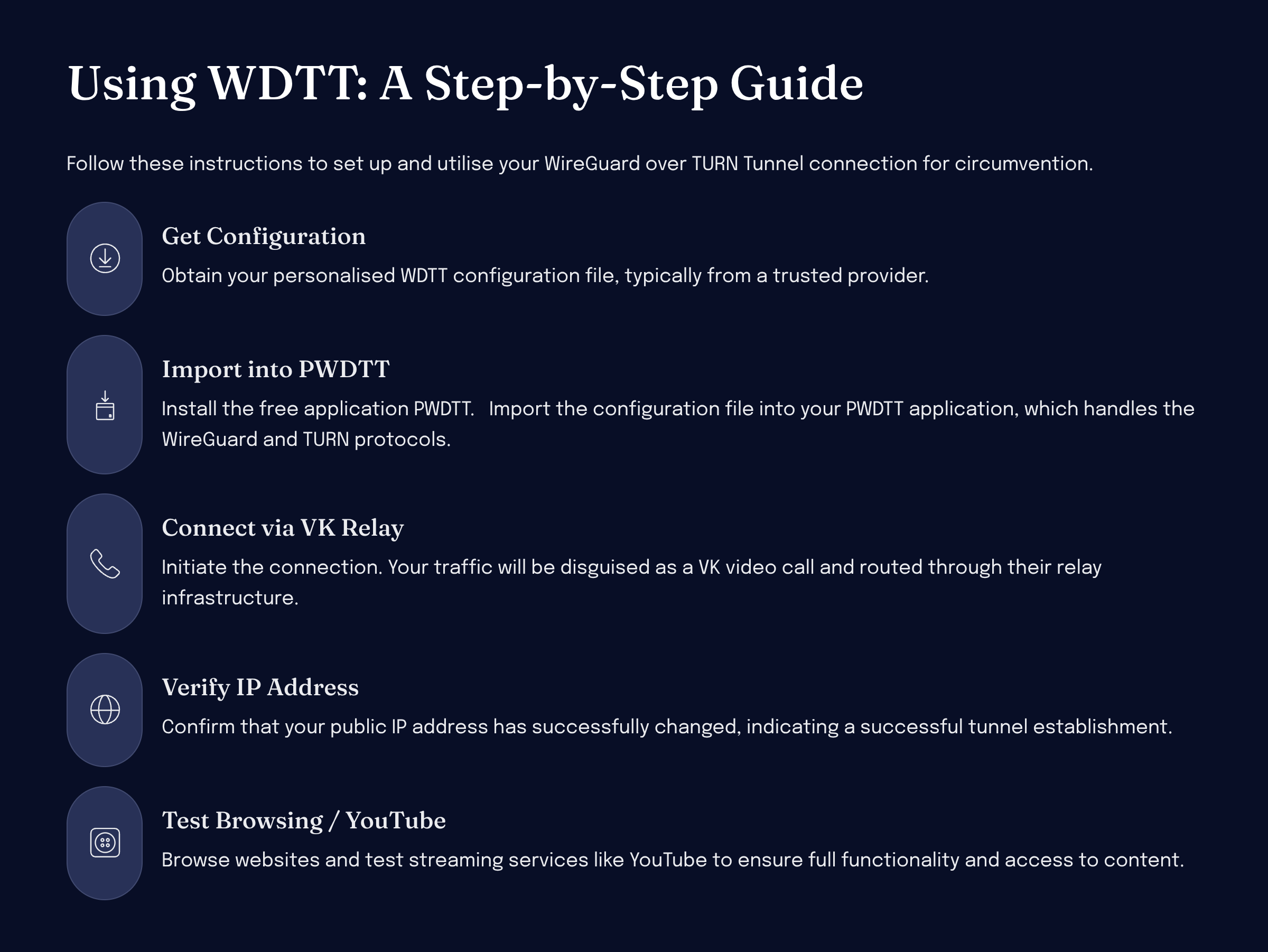
The setup involved obtaining a configuration through a Telegram bot, selecting a server, generating the required VK call information and then importing the resulting WDTT configuration into the Windows client. After running PWDTT with administrator privileges and connecting, my public IP address changed to an IP address in Germany.
That confirms that the tunnel itself was working correctly.
There is an important limitation to my test: I am not physically inside Russia, so I cannot personally demonstrate it bypassing Roskomnadzor filtering. Reports of it working against Russian restrictions therefore come from users actually inside the country rather than from my own connection.
Is This Just Another VPN?
Not quite. A normal VPN generally connects directly to a VPN server using a recognisable VPN protocol. WDTT adds another layer, using calling infrastructure as an intermediate transport.
That does not make it invisible or unblockable. VK could change its calling infrastructure. Russian filtering systems could adapt. The service providing the WDTT server could disappear. Performance may also be worse than a conventional VPN. Like most censorship-circumvention technology, it is part of an ongoing technical arms race.
Could Other Video-Call Services Be Used?
In principle, yes. The underlying idea is not unique to VK. Other WebRTC services also use technologies such as TURN relays, so similar techniques could potentially be adapted to other calling platforms.
However, that is not simply a matter of changing a setting. Each service has its own authentication systems, TURN credentials, protocols and network behaviour.
The version demonstrated in this video is specifically built around VK call infrastructure. What makes WDTT interesting is not simply whether this particular tool continues working. It demonstrates a much broader problem for internet censorship: whenever authorities leave one trusted communication channel open, developers will inevitably investigate whether that channel can be used to carry something else.
