
Last Updated on May 11, 2026
Privacy Groups Warn UK Age Verification Is Expanding Too Far
A coalition of digital rights organisations, VPN providers, and internet advocacy groups has issued a joint warning against the expansion of UK age-gate policies.
Their concern is not simply that one website or one type of content might require age checks. The bigger warning is that age verification could gradually become part of the wider infrastructure of the internet itself — affecting privacy, security, free expression, and open access for ordinary users.
The statement was signed by organisations including Mozilla, the Tor Project, the Electronic Frontier Foundation, Proton, Mullvad VPN, IPVanish, ExpressVPN, Open Rights Group, Big Brother Watch, Index on Censorship, and others.
A coordinated warning over UK age verification
The joint statement argues that UK policymakers are moving towards increasingly broad access restrictions online. The signatories warn that this approach risks making the web more restrictive, more centralised, and more dependent on identity-based access systems.
In their view, the issue is not just whether children should be protected from harmful content. The real question is how those protections are implemented — and whether the chosen tools end up changing the internet for everyone.
Age verification may sound like a narrow child-safety measure, but once it expands across platforms, apps, services, and infrastructure, the consequences become much wider.
What triggered the statement?
The statement responds to the passage of the Children’s Wellbeing and Schools Bill and the government’s subsequent consultation on expanding online age restrictions.

According to the statement, ministers are considering which platforms and specific features should be placed behind age gates. The signatories argue that the scope being discussed goes well beyond traditional adult-content websites and could involve a much wider range of online services.
The areas mentioned include:
- Social media platforms and specific features
- Video games and gaming communities
- VPN services
- Potentially even static websites
That last point is particularly significant. If age gates are extended to services such as VPNs or ordinary static websites, then the debate is no longer only about preventing children from accessing obviously harmful material. It becomes a debate about whether access controls could apply to core parts of the open web.
The coalition’s central argument
The coalition argues that UK policymakers are relying too heavily on what it describes as blunt access restrictions.
Their concern is that mandatory age verification shifts the burden onto users. Instead of redesigning online platforms to be safer by default, the system risks requiring ordinary people to prove their age or identity to access services that were previously open.
The groups argue that this treats restriction as the default response to online harms. Their alternative is to focus more directly on platform design, surveillance-driven business models, and the incentives that encourage companies to maximise engagement and data collection.
Privacy and security concerns
The statement also highlights the privacy and security trade-offs involved in large-scale age assurance systems.
Age verification systems can involve sensitive forms of personal data. Depending on the method used, that could mean ID documents, facial scans, biometric estimation, third-party verification services, account-based checks, or other identity-linked systems.
The coalition warns that existing age assurance technologies can be inaccurate, intrusive, or inaccessible for some users. It also argues that expanding these systems across more of the internet creates new data risks for everyone — not just children.
There is also a wider market concern. If age checks become a requirement across many services, large platforms, operating systems, and app stores may become even more powerful gatekeepers. Smaller websites and independent services may struggle to comply, while users may be pushed further into controlled platform ecosystems.
The risk of a fragmented web
One of the most striking phrases in the statement is the warning about a “patchwork of age-gated jurisdictions”.
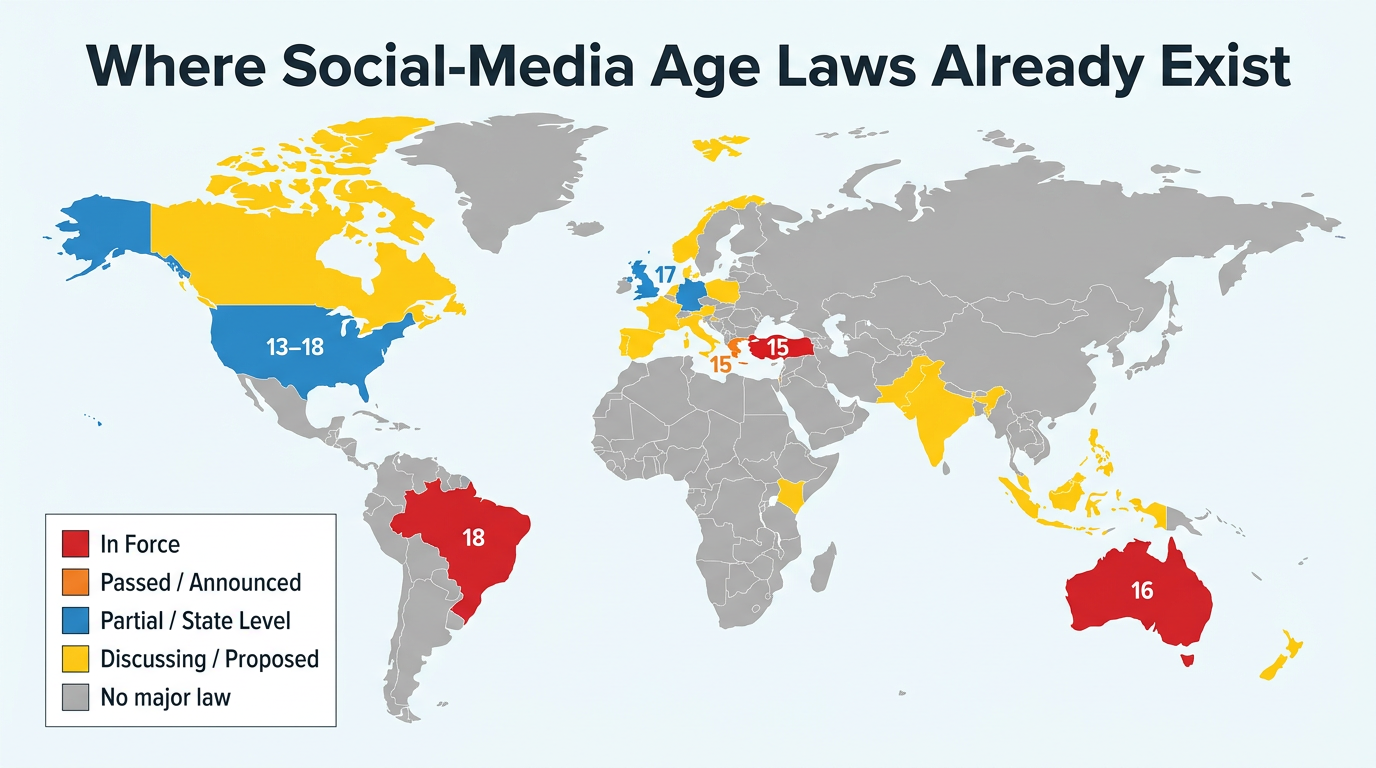
The concern is that the internet could become increasingly fragmented by region, age, and identity status. Instead of a broadly open global web, users in different countries could face different layers of verification before accessing information, communities, tools, or services.
This matters because the internet is not only used for entertainment. Young people may use it to find information they cannot safely access offline, including information about family abuse, politics, health, identity, or sexuality.
The coalition’s argument is that broad age gates may unintentionally close off access to important information, while still failing to tackle the deeper causes of online harm.
Not an argument for doing nothing
The statement does not deny that online harms exist. In fact, the signatories explicitly acknowledge that digital spaces can carry real risks, particularly for young people.
 The disagreement is about the policy response.
The coalition argues that governments should focus on effective and proportionate measures that protect children without undermining the rights and privacy of the wider population. In practice, that means putting more pressure on online platforms to reduce harmful design patterns, limit exploitative data collection, and create safer default experiences.
Why this debate matters
The age verification debate in the UK is now moving beyond individual websites. The involvement of organisations such as Mozilla, the Tor Project, EFF, Open Rights Group, Proton, Mullvad, and other privacy-focused groups suggests that opposition is becoming more coordinated and more public.
That matters because the policy question is also becoming broader.
If age verification remains limited to a narrow category of high-risk content, the debate looks one way. But if age verification becomes a general access layer for platforms, apps, VPNs, games, forums, and ordinary websites, then the debate changes completely.
At that point, the issue is not only child safety. It is also about the future structure of the web, the role of identity online, and whether internet access remains open by default.
Sources and further reading
- Joint Statement: UK policymakers must prioritise addressing the roots of online harm, not undermining the open web
- Open Rights Group
- Electronic Frontier Foundation
- Tor Project
- Mozilla
- Big Brother Watch
- Proton
- Mullvad VPN
- UK Parliament Bills
- UK Government: Online Safety Act / Online Safety Bill collection
This article is based on a video explainer about the joint statement against expanding UK age gates and the wider privacy, security, and open web concerns raised by the signatories.
